Recent Blog
Blog Categories
Film Making Tips
-
Creative Direction
-
Production Insights
Tags
Video Editing
Cinematography
Story Boarding
Lighting Design
Film Gear
Post Production
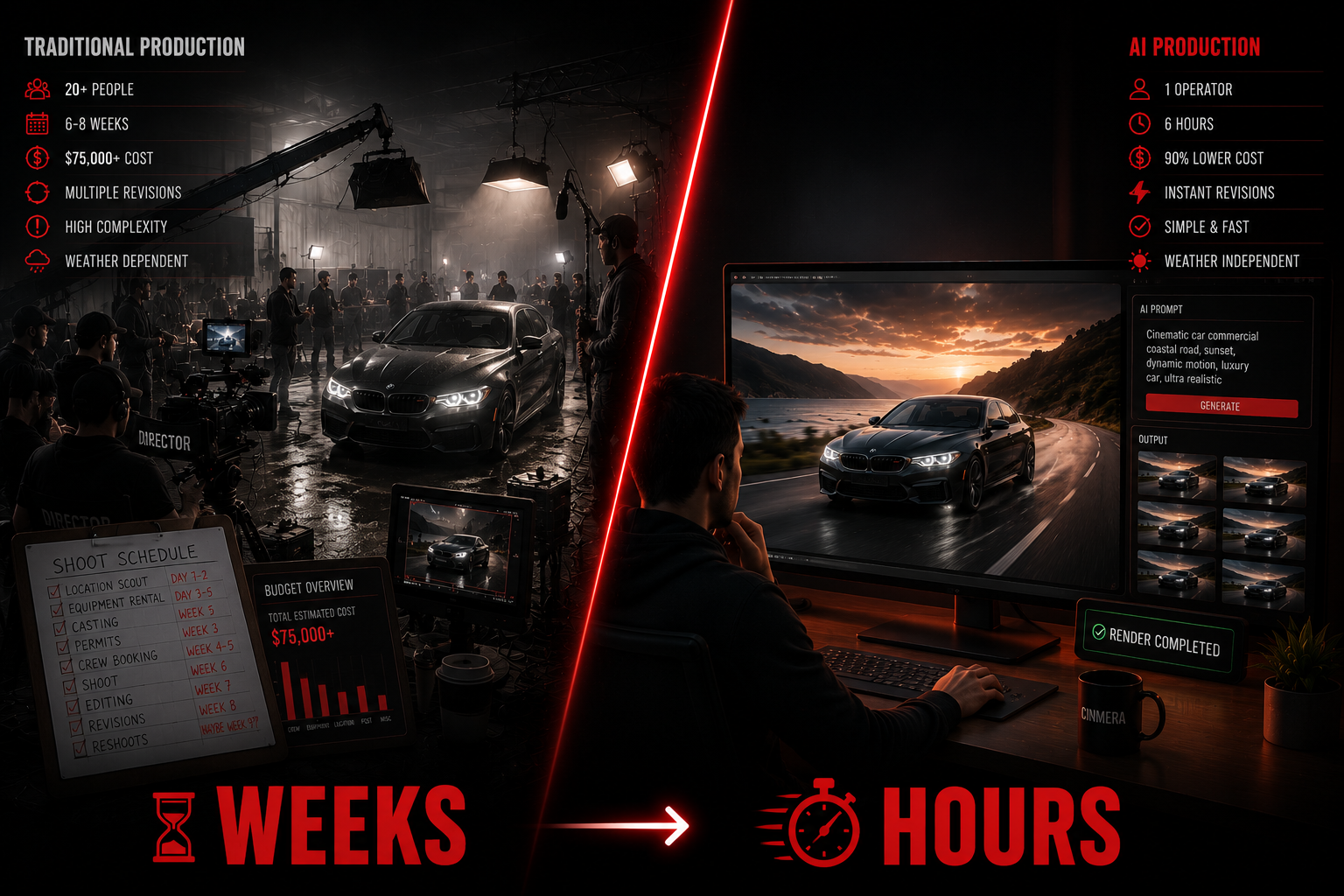
The Advertising Industry's Biggest Shift Since Digital Marketing
Just a few years ago, creating a high-quality commercial meant hiring a production house, scouting locations, arranging actors, booking equipment, coordinating multiple teams, and spending weeks—sometimes months—bringing an idea to life.
Today, brands are asking a very different question:
Should I spend ₹5 lakh to ₹50 lakh on a traditional shoot, or can I create the same impact using AI?
Artificial Intelligence is no longer a futuristic concept. It has become a practical production tool that is helping brands create commercials faster, more affordably, and at a scale that was previously impossible.
From startups and D2C brands to global enterprises, businesses are increasingly adopting AI commercial production to launch campaigns, test creative ideas, localize content, and produce marketing videos without the traditional limitations of time and budget.
The question is no longer whether AI will impact video production.
The question is how quickly brands will adapt.
Understanding AI Commercial Production
AI commercial production refers to the process of creating advertisements using generative artificial intelligence tools that can produce visuals, characters, environments, voiceovers, animations, and cinematic sequences from text prompts, images, or creative direction.
Instead of building every scene physically, brands can now generate:
- Product commercials
- Brand films
- Social media advertisements
- Explainer videos
- Training videos
- Multilingual campaigns
- Digital-first commercials
- Concept validation videos
The result is a production process that is significantly faster and more flexible than traditional methods.
Traditional Video Production vs AI Video Production
Traditional Production Model
A conventional commercial often requires:
- Creative agency
- Script writer
- Production team
- Director
- Actors
- Location rentals
- Equipment
- Lighting crew
- Makeup artists
- Editors
- Sound designers
- VFX artists
Even a relatively simple campaign can take weeks to execute.
AI Production Model
- Creative agency
- Script writer
- Production team
- Director
- Actors
- Location rentals
- Equipment
- Lighting crew
- Makeup artists
- Editors
- Sound designers
- VFX artists
Instead of managing dozens of moving parts, brands can focus on strategy, storytelling, and creative direction.
Cost Comparison: Traditional Production vs AI Commercials
One of the biggest reasons businesses are shifting toward AI advertising is cost efficiency.
Traditional Commercial Production
A professional commercial often includes:
- Location expenses
- Talent fees
- Equipment rentals
- Production crew
- Travel and logistics
- Post-production
Typical investment:
₹3 lakh to ₹50 lakh+
For larger campaigns, costs can reach several crores.
AI Commercial Production
With AI-generated commercials:
- No location expenses
- No talent coordination
- Minimal reshoot costs
- Reduced production overhead
The same creative concept can often be produced at a fraction of the traditional cost.
This allows brands to create more content, test more ideas, and achieve greater marketing efficiency.
Time Comparison: Weeks vs Days
Speed has become one of the most valuable competitive advantages in marketing.
Traditional Production Timeline
Typical workflow:
Concept Development → Script Writing → Pre-Production → Shoot → Editing → Revisions → Final Delivery
Timeline:
2–8 weeks
AI Production Timeline
Typical workflow:
Strategy → Script → AI Production → Editing → Delivery
Timeline:
2–7 days
Brands no longer need to wait months to launch campaigns.
This speed is particularly valuable for:
- Seasonal promotions
- Product launches
- Trend-based marketing
- Performance advertising
- Social media campaigns
Has AI Reached Professional Commercial Quality?
This is the question most business owners ask.
The answer is yes—and no.
AI has reached a point where it can create highly cinematic visuals, realistic environments, product demonstrations, digital actors, and compelling storytelling.
However, the quality of an AI commercial depends heavily on:
- Creative direction
- Storytelling ability
- Prompt engineering
- Visual consistency
- Editing expertise
- Brand understanding
The tools alone do not create great advertisements.
The team behind them does.
Just as owning a camera does not make someone a filmmaker, having access to AI tools does not automatically produce an effective commercia.
The brands achieving exceptional results are partnering with agencies that understand both marketing strategy and AI production.
Why Businesses Are Moving Toward AI Advertising
1. Faster Campaign Execution
Marketing opportunities move quickly.
Brands that launch faster often gain a competitive advantage.
2. Multiple Variations
A single commercial can become:
- 10 language versions
- 20 audience-specific variations
- 50 platform adaptations
without repeating the production process.
3. Better Testing
Instead of investing heavily in a single concept, brands can test multiple creative approaches and identify what works before scaling budgets.
4. Global Reach
AI allows businesses to create localized campaigns for different regions and markets faster than ever before.
5. Content Scalability
The modern marketing landscape requires a constant flow of content.
AI makes it possible to create large volumes of high-quality content while maintaining consistency.
Industries Benefiting Most from AI Commercial Production
Several industries are already seeing significant advantages.
Education & EdTech
- Course promotions
- Student success stories
- Concept explainers
Healthcare
- Awareness campaigns
- Patient education
- Service promotions
Real Estate
- Property visualizations
- Lifestyle storytelling
- Project launches
D2C Brands
- Product commercials
- Social media ads
- Performance marketing creatives
SaaS & Technology
- Product demonstrations
- Explainer videos
- Investor presentations
When You Should NOT Use AI
Despite its advantages, AI is not the right solution for every project.
Traditional production still has advantages when:
Celebrity Endorsements Are Required
If your campaign relies on a specific public figure, live production remains essential.
Documentary-Style Storytelling
Real human experiences often require authentic footage.
Live Events
Conferences, launches, and events need actual coverage.
Human-Centric Emotional Narratives
Certain stories benefit from genuine human performances that are difficult to replicate perfectly.
The smartest brands are not choosing AI instead of traditional production.
They are choosing the right tool for the right objective.
The Future of Commercial Production
The future is unlikely to be purely traditional or purely AI.
It will be a hybrid model.
Brands will use:
- Traditional production for premium storytelling
- AI production for scalability
- AI-assisted editing for efficiency
- Multilingual AI localization for expansion
The companies that learn to combine creativity with AI will outperform those relying solely on conventional production methods.
Final Thoughts
AI is not replacing creativity.
AI is replacing inefficiency.
The brands that thrive in 2026 and beyond will be those that leverage AI to create faster, test smarter, scale wider, and connect with audiences more effectively.
Commercial production is entering a new era where cinematic quality is becoming more accessible than ever before.
Businesses no longer need massive budgets to tell powerful stories.
They need the right strategy, the right creative vision, and the right production partner.
Share:
Latest Insights in Film, Video & Creativity
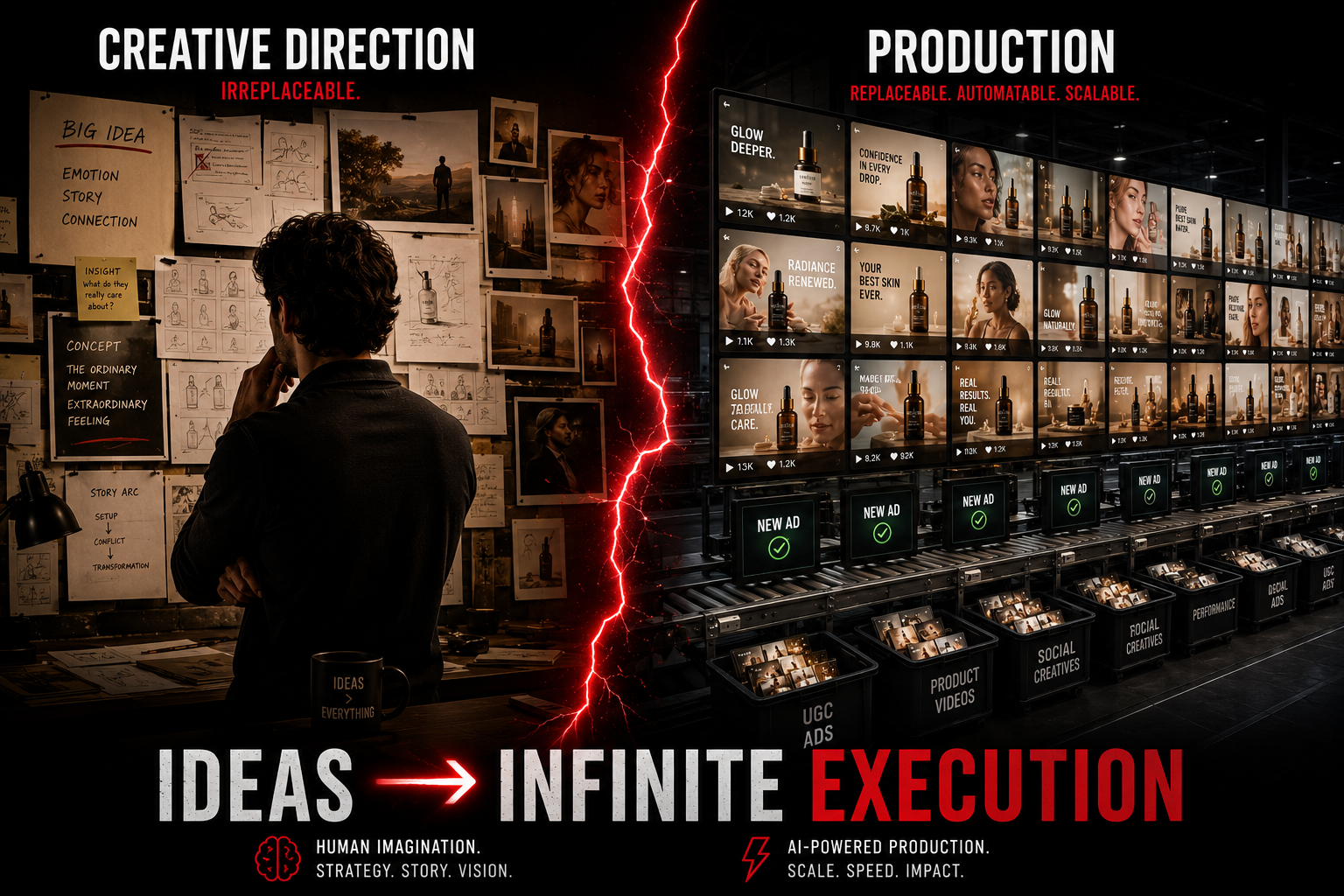
The rise of AI-generated videos has sparked a question across the advertising, filmmaking, and content industries:
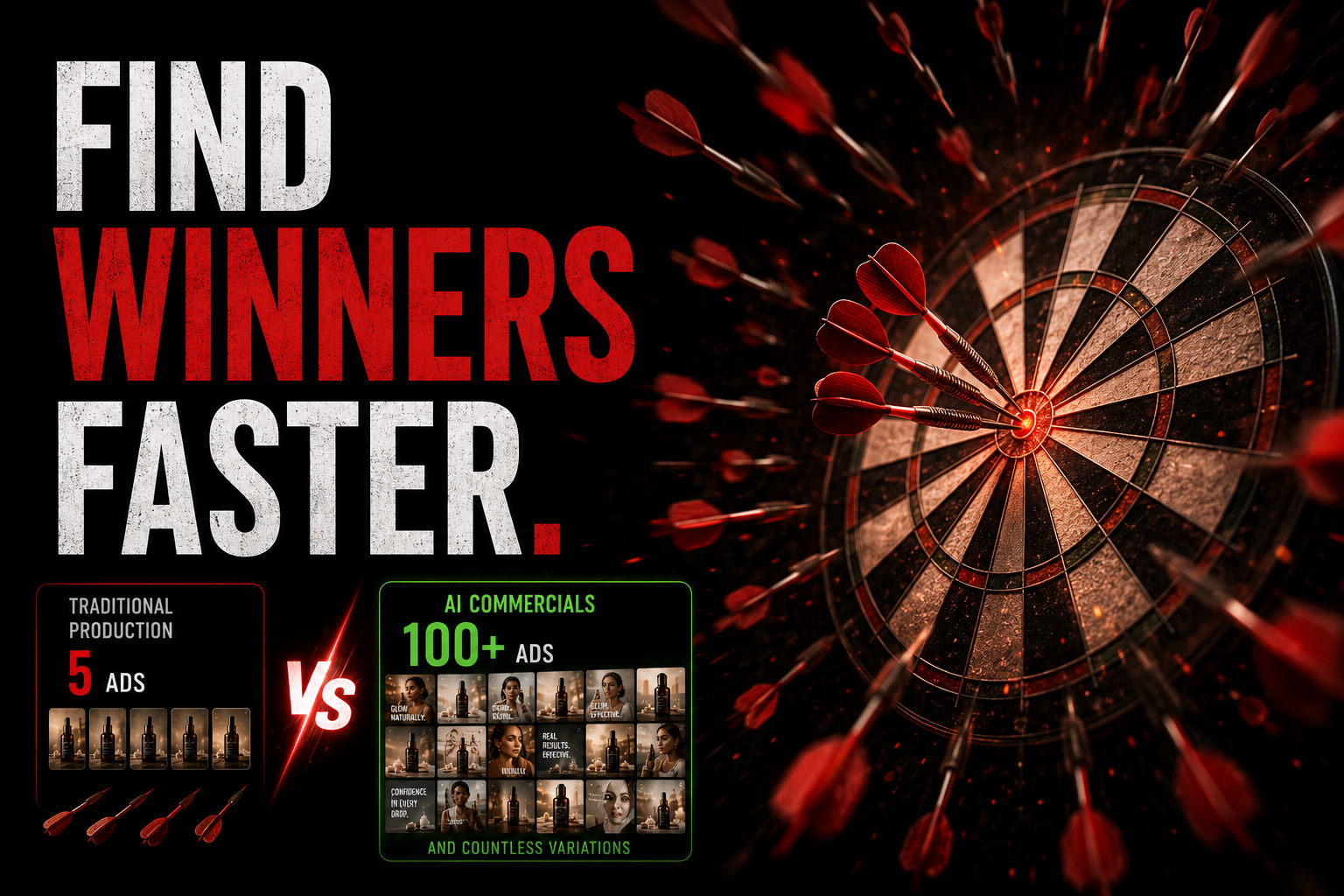
For D2C brands, one metric determines whether growth is sustainable: